
Although many people associate the Amazon River with Brazil, its story actually begins much higher up, in the Andes of Peru. Understanding how the Amazon is formed and distributed within the country allows you to better appreciate the immense scale of this iconic river.
Far from being a single channel that suddenly appears, the Amazon River is the result of the convergence of multiple rivers and tributaries that descend from the Andean mountain range and intertwine throughout the rainforest. In the Loreto region, these rivers form a complex fluvial network that sustains one of the richest ecosystems on the planet.
More than just a river, the Amazon in Peru functions like a living system, a network of natural pathways that connects communities, supports extraordinary biodiversity, and serves as the main mode of transportation in the northern jungle of the country.
Understanding this “map” not only helps you navigate it better, but also allows you to see the Amazon from a different perspective: not as a single river, but as a vast web of life that begins much earlier than most people imagine.
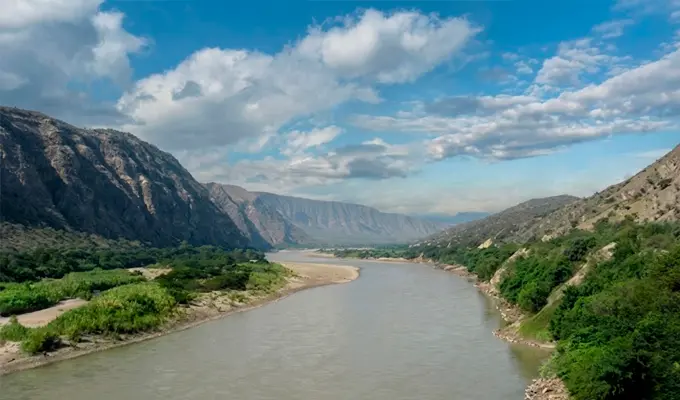
The point that many maps identify as the official source of the Amazon River is located near the small town of Nauta, about 100 kilometers south of Iquitos. More than just a geographical fact, this place has something special: it’s where two massive rivers meet to give rise to one of the most impressive river systems on the planet.
At this point, the Ucayali River flowing from the south and the Marañón River descending from the west converge. Both carry sediment-rich waters, and when they join, they officially form the Amazon River. Seeing this confluence on a map or even better, in person is like watching the great arteries of the continent connect.
This confluence is not only geographically significant, but also symbolic. For many, it represents the true beginning of the Amazon’s journey, which is why it is also a common starting point for river cruises heading deep into the rainforest. It’s a place where the sheer scale of nature becomes evident from the very first moment.
Following its course to the northeast, the Amazon River reaches Iquitos, a city known for a unique distinction: it is the largest city in the world that cannot be reached by road. It is only accessible by air or by river, which already gives a sense of its deep connection to the rainforest.
On any map of the region, Iquitos stands out as a major point of reference. More than just a city, it functions as the logistical heart of the Peruvian Amazon. From here, the river becomes an essential route for transporting people, goods, and expeditions heading toward the borders with Colombia and Brazil.
Its location is no coincidence. Situated on the banks of the Amazon, the city serves as a key port and a starting point for all kinds of journeys. For travelers, Iquitos is the gateway to the jungle: from here begin explorations into flooded forests, natural reserves, and the mysterious blackwater tributaries that merge with the main river.
More than a destination in itself, it is the beginning of a much deeper experience in the Amazon.
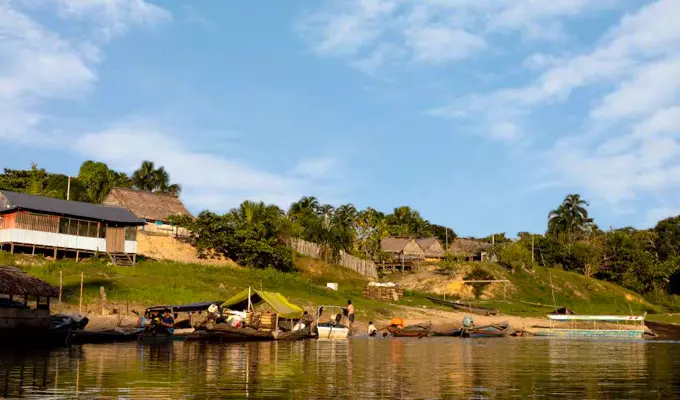
Southwest of the main course of the Amazon River lies one of the most fascinating places in the Peruvian Amazon: the Pacaya Samiria National Reserve. This vast protected area is a key feature on any ecological map of the country not only because of its size, but also due to the incredible life it sustains.
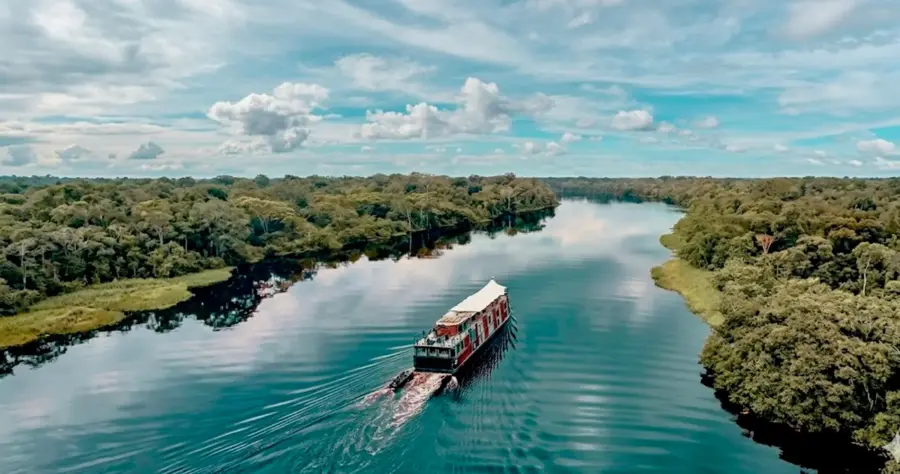
The reserve is located between the very rivers that give rise to the Amazon the Marañón River and the Ucayali River forming an environment where water connects everything. When looking at its geography, what stands out most is its complex network of blackwater rivers. These rivers have their dark color due to tannins released from the decomposition of leaves and organic matter in the rainforest.
But far from being murky, this phenomenon creates one of the most striking landscapes in the region. The surface of the water becomes so reflective that it looks like a perfect mirror, where the sky, clouds, and jungle blend together until they become almost indistinguishable.
Navigating these rivers is a unique experience not only because of the visual sensation, but because you are traveling through one of the most biodiverse ecosystems on the planet. It’s a place where nature reveals itself in its purest form, and where every journey feels like stepping into a completely different world.
The Triple Border: where everything connects
If you follow the course of the Amazon River eastward, you’ll reach a place as curious as it is fascinating: the region where Peru, Brazil, and Colombia meet. At this point, the Peruvian Amazon passes through Santa Rosa Island before continuing its journey into Brazilian territory. It’s a unique place, where crossing from one country to another can be as simple as taking a short boat ride along the river. For many travelers, this experience of crossing borders by water is something completely different from what they’re used to.
Amazon River Cruises: a different kind of experience
Exploring the Amazon from the water is, without a doubt, one of the most complete ways to experience the rainforest. Most cruises focus on the stretch between Iquitos and the Pacaya Samiria National Reserve, where biodiversity is simply astonishing. Here, understanding the behavior of the river is key: traveling during the high-water season is very different from the low-water season. The water level completely transforms the landscape, navigation routes, and even the way the jungle is explored.
Hidden Tributaries: where the experience becomes more intimate
Beyond the main channel, there are lesser-known rivers that offer an even closer connection to the Amazon. The Napo River, for example, flows toward Ecuador and opens the way to more remote areas. The same is true of the Nanay River, whose waters lead to quieter, less-traveled landscapes.
It’s in these tributaries where the experience changes completely. Far from the more crowded routes, it becomes easier to have authentic encounters with local communities and discover a way of life deeply connected to the natural environment. Here, the journey stops being just a trip and becomes a true immersion in the rainforest.