
The flag of Peru is much more than a combination of red and white; it is a symbol that reflects a nation’s journey in search of freedom and identity. Over more than two centuries, it has undergone several changes, each one telling a part of Peru’s political and social history. From the initial vision of General José de San Martín to the legal decisions promoted by Simón Bolívar, the flag gradually took shape into what it represents today: a country proud of its independence and its cultural richness.
Understanding the history of the Peruvian flag is a way of getting closer to the soul of Peru, because in every detail there are stories of struggle, sacrifice, and also the great natural diversity that defines the country.
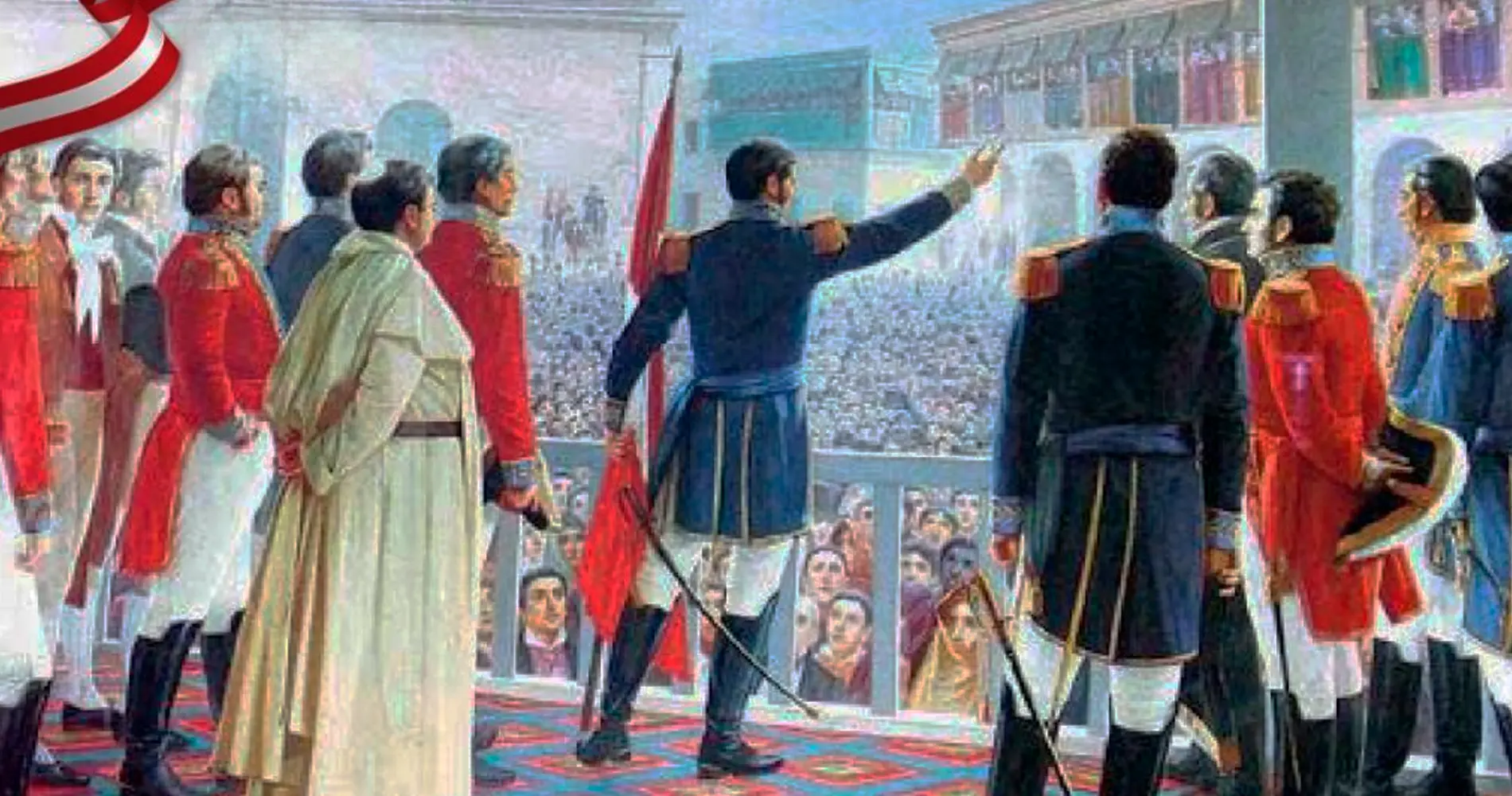
The history of the Peruvian flag begins on October 21, 1820, when General José de San Martín, from his headquarters in Pisco, decreed the creation of the first official flag of the independent country.
Around this moment, there is a well-known legend: it is said that the Liberator, while resting under a palm tree after arriving on the Peruvian coast, had a dream and, upon waking, saw a flock of parihuanas flamingos with intense red wings and white chests flying on the horizon. This image inspired him to choose the colors that today represent Peru.
That first flag, however, was very different from the current one. It was divided into four triangular sections by diagonal lines: the upper and lower parts were white, while the side sections were red. At the center, it featured a coat of arms with a laurel wreath and a rising sun behind the imposing Andes Mountains, symbolizing the beginning of a new era of freedom for the Peruvian people.
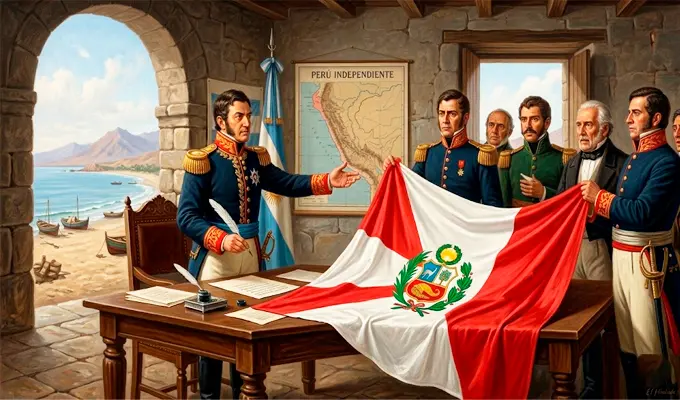
At the beginning of 1822, the original design with diagonal lines began to present a practical problem: it was difficult to reproduce consistently. For that reason, the Marquis of Torre Tagle, who was in charge of the government at the time, decided to make a change and proposed a second version of the flag.
This new design featured three horizontal stripes: red at the top and bottom, and white in the center, with a red sun in the middle. However, a serious issue arose on the battlefield. From a distance, the flag looked too similar to Spain’s, which caused confusion among the troops.To resolve this, just a few months later, in May 1822, Torre Tagle modified the design once again. This time, he changed the orientation of the stripes to vertical, creating the red-white-red format we know today. This adjustment was key, as it established the foundation of the current design and helped solidify a clear and distinctive symbol for the country.
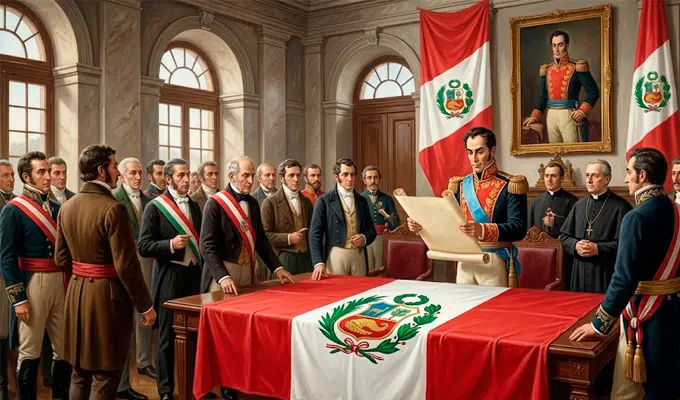
The flag of Peru took its definitive form during the government of Simón Bolívar. On February 25, 1825, the Constituent Congress approved the Law of National Symbols, officially confirming the three vertical stripes that we all recognize today.
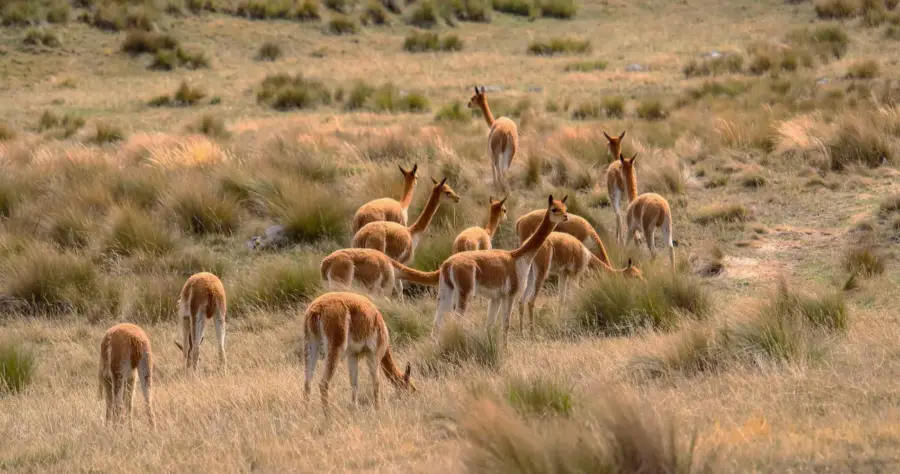
One of the most important changes at that time was the design at the center of the flag. The old sun was replaced by the National Coat of Arms of Peru, a more complete and representative symbol of the country. This coat of arms brings together elements that highlight Peru’s natural wealth: the vicuña representing the animal kingdom, the cinchona plant representing the plant kingdom, and the cornucopia spilling gold coins representing the mineral kingdom.
With this design, Peru showed the world its great diversity and abundance. Since then, the 1825 flag has remained in use, accompanying the most important moments in history and reflecting the pride and identity of the Peruvian people.
What do the colors of the Peruvian flag mean?
The most well-known explanation says that red represents the blood of the heroes who fought for the country’s freedom, while white symbolizes peace, purity, and the desire for justice. It’s a simple way to understand the spirit and values that define Peru.
Who created the first flag of Peru?
The first version was designed by General José de San Martín in 1820. It had a very different design from the current one, featuring a diagonal cross, and today it can be seen in historical representations that recall the early days of independence.
What is the difference between the National Flag and the National Ensign?
The National Flag is the simple red and white version that people can use in their homes or during celebrations. In contrast, the National Ensign includes the Peruvian Coat of Arms in the center and is reserved for state institutions, such as public buildings or the Armed Forces.
Why is there a tree on the coat of arms?
That tree is the cinchona. It was included because it produces quinine, a very important medicine used to treat diseases such as malaria. It symbolizes Peru’s contribution to the world and the country’s rich natural resources.