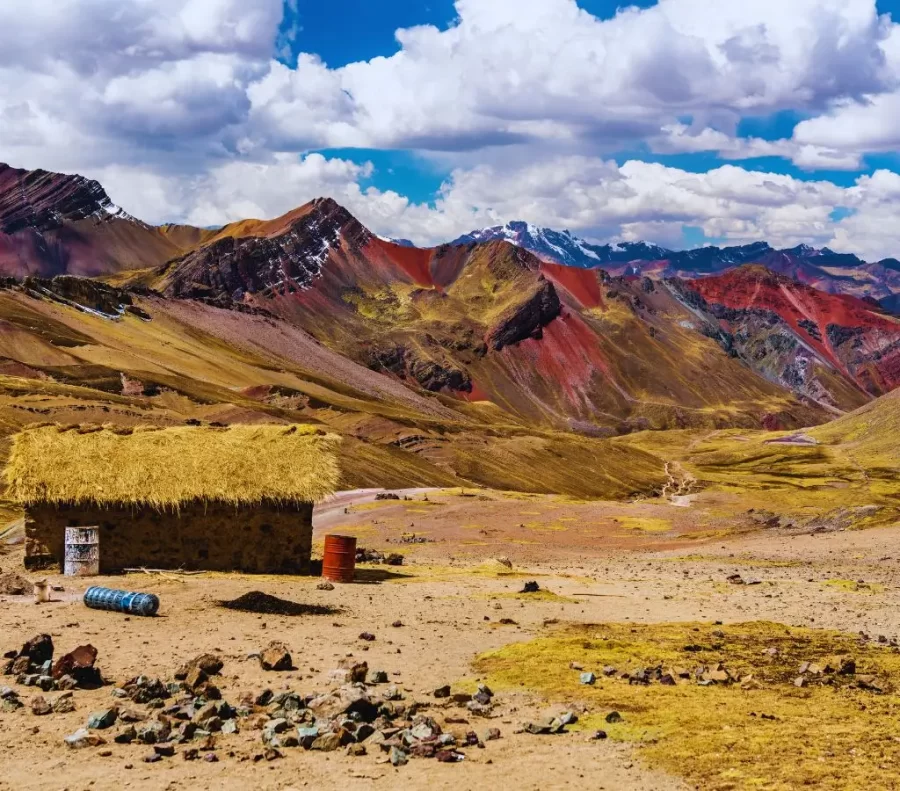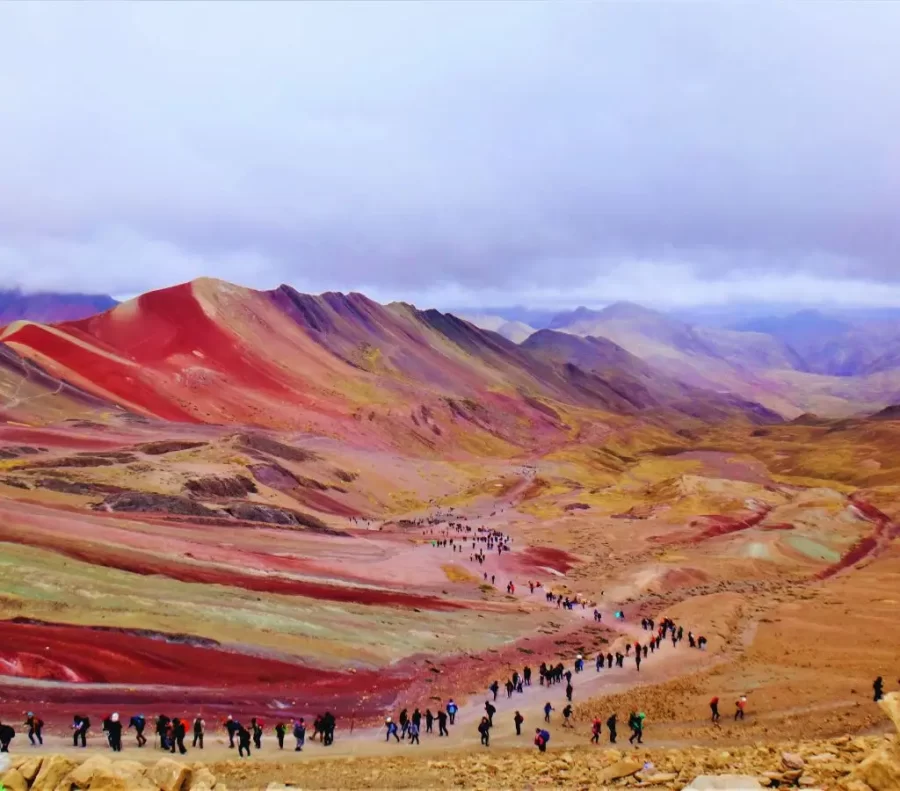

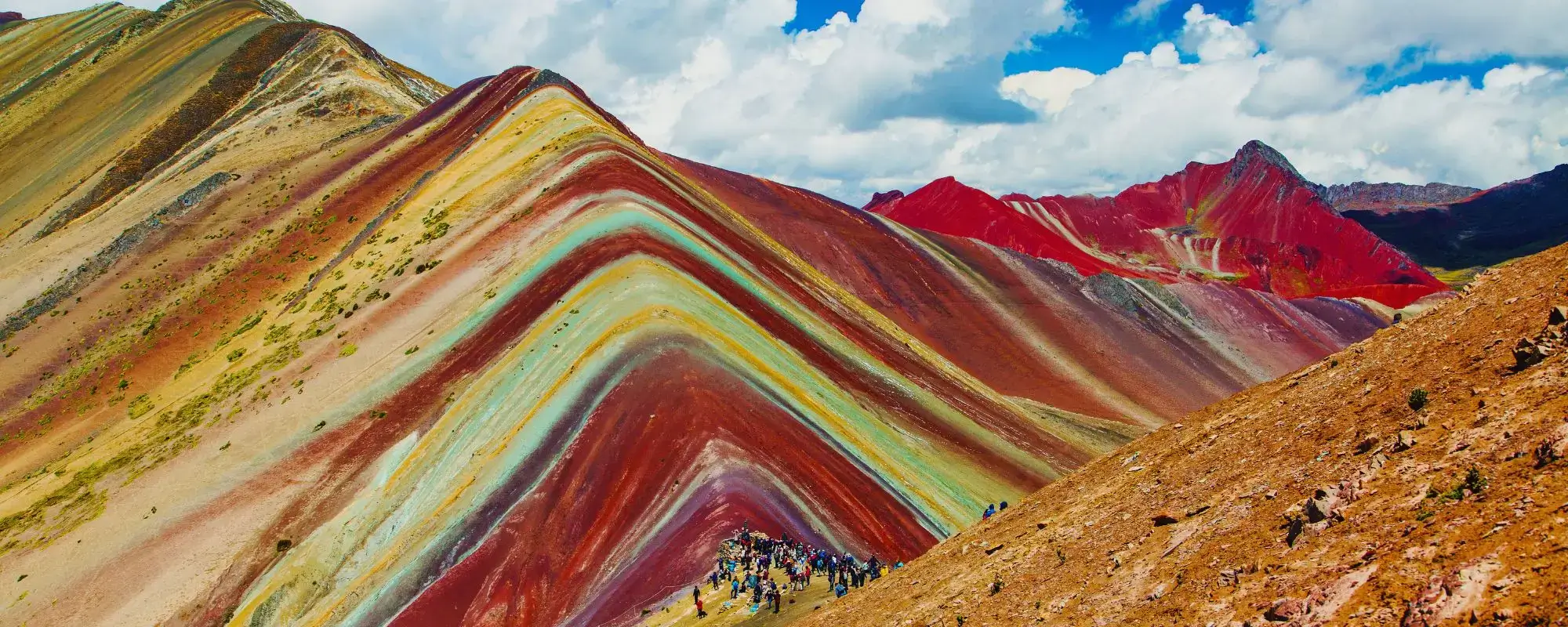
Rainbow Mountain in Cusco, Peru, locally known as Vinicunca and also called the Mountain of Seven Colors or Montaña de Colores, is one of the most extraordinary natural landscapes in the Peruvian Andes. Rising to approximately 5,036 meters above sea level, this remarkable mountain is famous for the colorful mineral layers that stretch across its slopes, creating the distinctive rainbow-like appearance that has made it one of the most visited natural attractions near Cusco.
But visiting Vinicunca is about much more than reaching a colorful mountain. The journey takes travelers deep into the high-altitude landscapes of the Andes, passing through remote valleys, traditional communities, and areas where alpacas and llamas graze beneath imposing mountain peaks. As you move farther away from Cusco, the scenery becomes increasingly dramatic and offers a glimpse into a very different side of the region.
Reaching Rainbow Mountain requires some effort. Most travelers visit on a full-day trip from Cusco, combining an early road journey with a high-altitude hike through the mountains. The walk can feel challenging, particularly because of the elevation, but the changing scenery along the trail makes the experience just as memorable as arriving at the famous viewpoint itself.
Once there, the landscape reveals why Vinicunca has captured the attention of travelers from around the world. Its unusual colors, immense Andean surroundings, and remote location create a setting that feels completely different from the archaeological attractions for which Cusco is best known.
In this guide, you will discover where Rainbow Mountain is located, what creates its famous colors, how to get there from Cusco, what the hike is really like, and what to expect from the altitude and weather. You will also find practical information about the best time to visit and the different ways to experience Vinicunca, helping you prepare for one of the most memorable mountain adventures in Cusco.
| Information | Details |
| Location | Cusco region, Peru |
| Altitude | Approximately 5,036 m above sea level |
| Hiking distance | Approximately 5 km |
| Hiking time | Approximately 2 hours, depending on physical condition |
| Difficulty | Moderate, with altitude being an important factor |
| Best season | June to September |
| Starting point | Cusco |
| Main access route | Via Cusipata and Phulawasipata |
| Entrance fee | Paid locally; amount not specified in the original information |
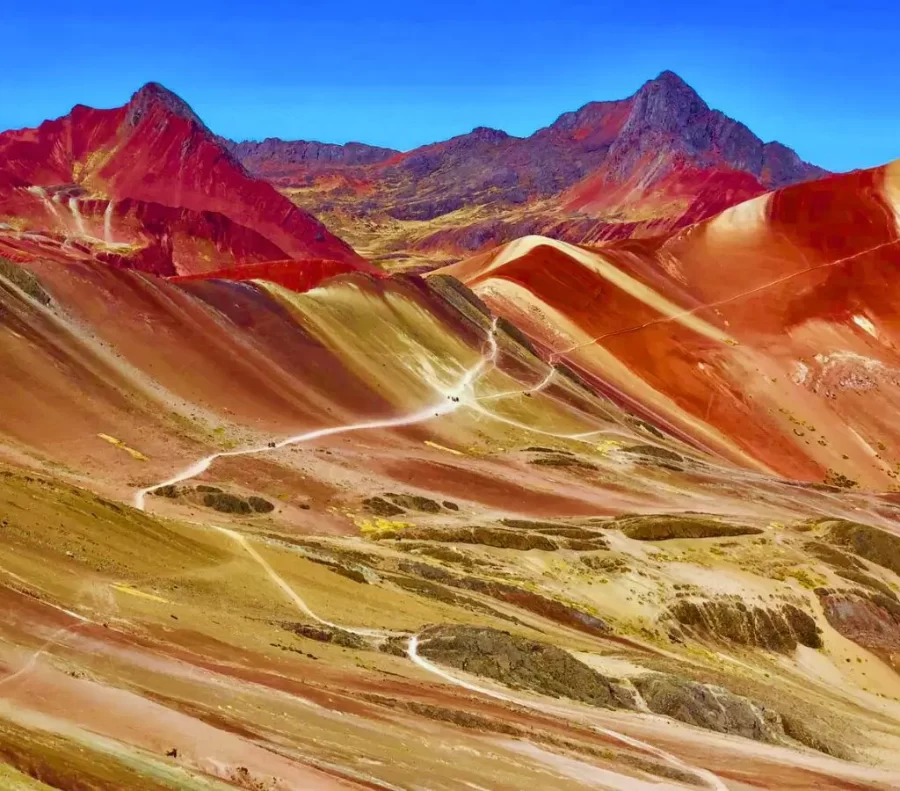
Rainbow Mountain, or Vinicunca, is a high-altitude mountain in the Cusco region known for the remarkable bands of color that naturally cover its slopes. Shades of red, pink, green, yellow, white, and purple blend across the landscape, creating the rainbow-like appearance that has made this corner of the Peruvian Andes so distinctive.
However, the experience of visiting the Mountain of Seven Colors goes far beyond taking a photograph at the famous viewpoint. The journey itself is an important part of the adventure, taking travelers through wide-open valleys, rugged mountain scenery, and remote areas where everyday life still follows the rhythm of the Andes.
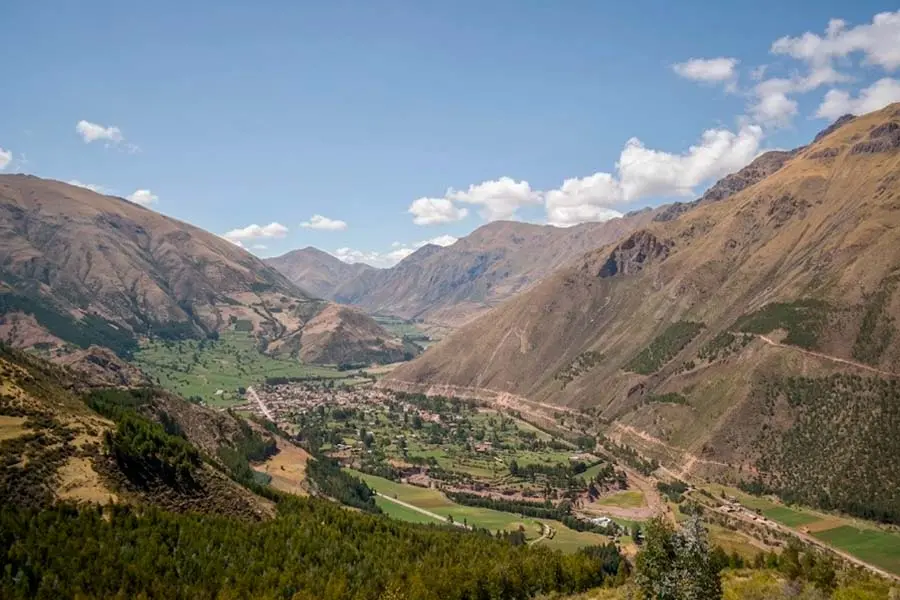
Along the way, you may see snow-capped peaks rising in the distance, herds of alpacas and llamas grazing across the highlands, and local communities surrounded by an immense natural landscape. Depending on the route and conditions, small mountain lakes and wetlands can also become part of the scenery.
For many travelers, this combination of nature, altitude, and local life is what makes Vinicunca particularly memorable. It is a chance to leave the streets of Cusco behind for a day and experience the remote beauty of the Peruvian Andes, where the journey to the mountain can be just as impressive as the destination itself.
Vinicunca is located in the Cusco region of Peru and reaches an altitude of more than 5,000 meters above sea level. The journey begins in the city of Cusco and continues by road toward the communities that provide access to the hiking trail.
The most commonly used route passes through Cusipata before continuing toward Phulawasipata, where the hike to Rainbow Mountain begins. See our detailed guide to where Rainbow Mountain is located for more information about its geographical setting, access routes and distance from Cusco.
Because of its remote location, visiting Vinicunca normally requires a combination of road transportation and hiking.
The extraordinary colors of Vinicunca Rainbow Mountain are the result of a geological process that developed over millions of years. Different layers of sediment containing minerals and other geological materials accumulated in the area, eventually creating the colorful bands that can now be seen across the mountain’s slopes.
Each color is associated with a different mineral composition. The red and pink tones are linked mainly to iron-rich sediments, clays, and other materials that have oxidized over time. White sections are associated with lighter materials such as quartz-rich sands and limestone, while the purple or lavender tones are related to combinations of clay, carbonates, and silicate minerals.
The green shades are associated with mineral-rich clays containing elements such as iron and magnesium, while yellow, mustard, and golden areas are linked to minerals and sediments that include limonite and sulfide-bearing materials.
Rather than appearing suddenly, these colorful layers are part of the mountain’s geological history. Over time, erosion and the gradual retreat of the snow and ice that once covered parts of the landscape helped expose the mineral-rich formations beneath the surface.
Today, the combination of red, pink, green, yellow, white, and purple layers creates the remarkable striped landscape that has earned Vinicunca its famous names: Rainbow Mountain and the Mountain of Seven Colors.
Getting to Rainbow Mountain from Cusco is an adventure that combines a scenic road journey through the Andes with a high-altitude hike to Vinicunca. Most visits begin early in the morning, allowing travelers enough time to reach the mountain, complete the hike, and return to Cusco later in the day.
The first part of the journey is by road from Cusco toward Cusipata, a town located south of the city. The drive takes approximately two hours, although travel time can vary depending on traffic, road conditions, and the transportation service used. As you leave Cusco behind, the urban landscape gradually gives way to valleys, small Andean communities, farmland, and increasingly impressive mountain scenery.
From Cusipata, the journey continues deeper into the highlands toward the area used as the starting point for the hike to Vinicunca. This final stretch by road takes travelers into a much more remote environment, surrounded by open valleys, grazing areas, and high Andean peaks.
Once at the trailhead, the adventure continues on foot. Much of the route follows a gradual ascent through the high-altitude landscape, giving hikers time to appreciate the scenery as they approach Rainbow Mountain. The effects of the altitude, however, can make even gentle sections feel more demanding than expected.
The most noticeable climb comes during the final approach to Rainbow Mountain, where the trail becomes more demanding before reaching the main viewpoint. From there, the colorful slopes of Vinicunca finally come into view, surrounded by the dramatic mountains that make this part of the Cusco region so memorable.

For travelers who prefer to focus on the experience rather than organizing transportation on their own, joining an organized Rainbow Mountain tour from Cusco is one of the most convenient ways to visit Vinicunca. These excursions bring together the different stages of the journey into a single full-day experience, from leaving Cusco to reaching the high-altitude trail and returning to the city.
Traveling with an organized tour also means having a guide along the way who can provide context about the landscape, local communities, and the natural features that make Rainbow Mountain such a distinctive destination in the Peruvian Andes.
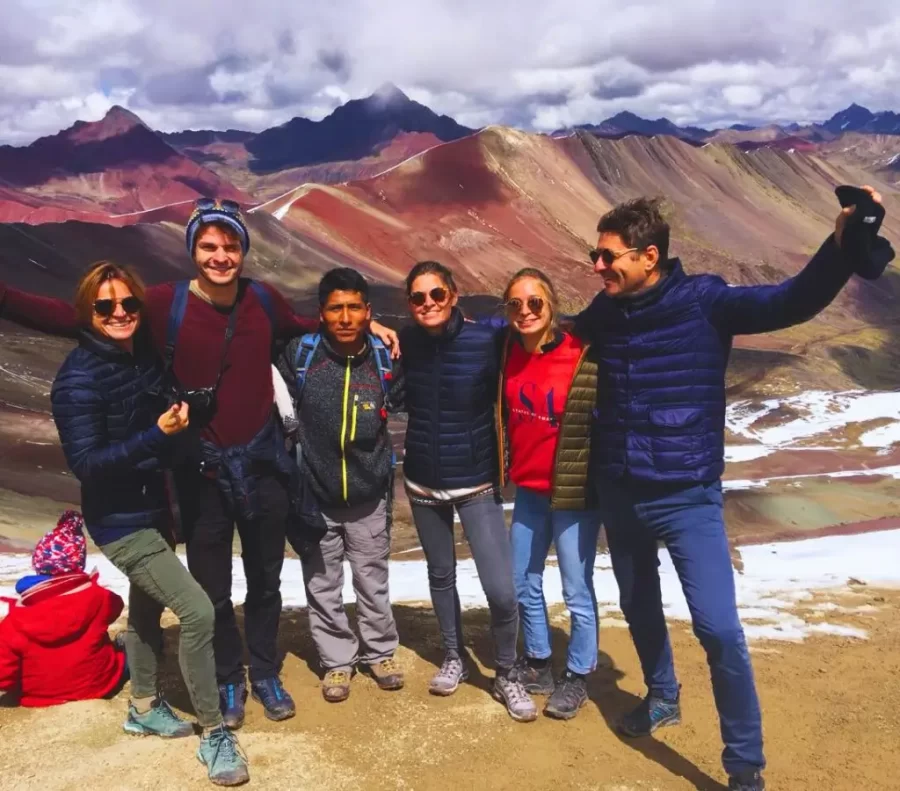
With Terandes, travelers can experience Vinicunca as part of a guided excursion from Cusco, accompanied by professional guides and with the main travel arrangements organized in advance. This allows you to concentrate on the hike, enjoy the changing Andean scenery, and make the most of your time at the Mountain of Seven Colors without having to coordinate each stage of the journey independently.
It is also possible to visit Rainbow Mountain independently, which can be an appealing option for travelers who prefer greater flexibility and are comfortable organizing each stage of the journey themselves.
Unlike joining an organized tour, traveling on your own requires coordinating transportation from Cusco toward the communities that provide access to the Vinicunca trail. Depending on the available services and access conditions, this may involve combining different forms of local transportation before reaching the starting point of the hike.
Travelers should also be prepared to pay the local entrance fee to Rainbow Mountain upon arrival. Since payment facilities can be limited in remote Andean communities, carrying enough cash for entrance fees, transportation, food, and other small expenses is highly recommended.
Card payments and digital payment options may not always be available, particularly once you leave the main towns and travel deeper into the highlands. Having cash on hand can make the journey much easier and help avoid unnecessary complications.
Visiting Vinicunca independently offers more freedom, but it also requires careful planning, particularly when it comes to transportation, timing, weather conditions, and the return journey to Cusco.
The route through Cusipata is one of the most commonly used ways to reach Rainbow Mountain from Cusco. After arriving in Cusipata, travelers continue deeper into the highlands toward the access area for the Vinicunca trail, where the journey by road gives way to the hike.
Traditionally, the route continues toward Phulawasipata, an area associated with access to the hiking trail. From this point, travelers enter a much more remote Andean landscape, surrounded by open valleys, high mountain scenery, and areas where llamas and alpacas can often be seen grazing.
This route is popular because it provides relatively direct access to the main hiking area leading toward Vinicunca. From the trailhead, the walk gradually gains elevation before becoming more demanding during the final approach to the famous Mountain of Seven Colors.
For many visitors, the Cusipata route is not simply a way to reach Rainbow Mountain. The changing landscapes along the journey—from rural communities and valleys to the high-altitude scenery of the Peruvian Andes—are an important part of the experience itself.
The Pitumarca route offers an alternative way to reach Rainbow Mountain and is generally a longer journey than the more commonly used route through Cusipata. It can be an interesting option for travelers who want to explore a different approach through the high-altitude landscapes south of Cusco.
The journey begins by traveling from Cusco toward Checacupe, located approximately two hours from the city. From there, the route continues toward the district of Pitumarca, taking travelers farther into a rural Andean environment surrounded by valleys, mountains, and small communities.
After reaching Pitumarca, the journey continues toward the access area for the hike to Vinicunca. Depending on the exact starting point, road conditions, and current access arrangements, travel and hiking times can vary, so visitors should allow enough time for the complete excursion.
Once on foot, the landscape becomes increasingly remote as the trail climbs through the highlands toward the Mountain of Seven Colors. The altitude makes the walk physically demanding, but the journey offers an opportunity to experience a quieter side of the Andes before reaching the colorful slopes of Vinicunca.
Compared with the Cusipata approach, the Pitumarca route generally requires more travel time and planning, making it particularly suitable for travelers who value the journey through the Andean landscape as much as reaching Rainbow Mountain itself.
The Rainbow Mountain hike is not particularly technical, but the high altitude makes it more challenging than many travelers initially expect. Much of the trail follows a gradual ascent through open Andean terrain, allowing hikers to walk at their own pace while enjoying the surrounding mountains, valleys, and high-altitude scenery.
The greatest challenge is not necessarily the distance or the terrain, but the elevation. As the route climbs toward Vinicunca, the thinner air can make even a steady walk feel considerably more demanding than a similar hike at lower altitudes. Taking your time and avoiding an unnecessarily fast pace can make a noticeable difference.
The final approach to Rainbow Mountain is generally the most demanding part of the experience. The ascent becomes more noticeable as hikers make their way toward the main viewpoint, where the colorful slopes of Vinicunca gradually reveal themselves against the surrounding mountains.
Reaching the viewpoint is the reward for the effort. At more than 5,000 meters above sea level, travelers can stop to appreciate the extraordinary colors of Rainbow Mountain and the vast Andean landscape that surrounds it. The combination of altitude, scenery, and the sense of reaching such a remote location makes the hike one of the most memorable outdoor experiences near Cusco.
The complete Rainbow Mountain trekking route covers approximately 5 kilometers, although the exact walking distance can vary depending on the access point and current trail conditions. Most visitors complete the journey on foot, following the high-altitude trail through the open Andean landscape toward Vinicunca.
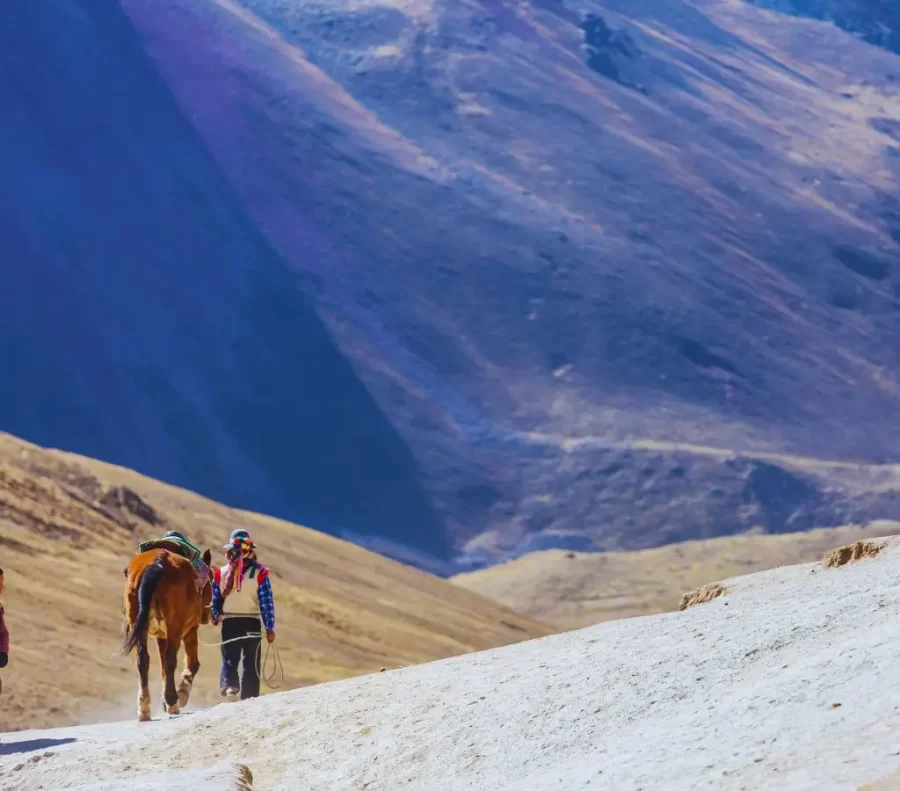
For travelers who find the altitude particularly demanding, horses may be available for part of the route. Local residents commonly provide this service near the trail, offering an alternative for visitors who prefer to reduce the amount of walking required.
However, taking a horse does not mean avoiding the hike completely. Horses generally cover only part of the trail, and visitors must still walk the final section to reach the Rainbow Mountain viewpoint. This last stretch can feel challenging because of the elevation and the steeper approach to the mountain.
Whether you choose to walk the entire route or use a horse for part of the journey, it is important to remember that Vinicunca is located at more than 5,000 meters above sea level. Taking your time and approaching the experience at a comfortable pace will allow you to better enjoy the remarkable scenery along the way.
The Rainbow Mountain hike takes approximately two hours, although the actual duration can vary considerably from one traveler to another. Your walking pace, physical condition, weather, trail conditions, and especially how your body responds to the altitude can all influence the time needed to reach Vinicunca.
For this reason, the hike should not be judged by distance alone. While the route may seem manageable on paper, Rainbow Mountain rises above 5,000 meters above sea level, where the thinner air can make walking feel noticeably more demanding than it would at lower elevations.
There is no need to rush. Walking at a comfortable pace and allowing time for short breaks gives you the opportunity to adjust to the effort while also enjoying the dramatic Andean scenery along the trail.
The journey is part of the experience itself. With mountains, open valleys, and herds of alpacas and llamas often forming part of the landscape, reaching Vinicunca is about much more than simply completing the distance.
Much of the Rainbow Mountain trail follows a relatively gradual route through the high Andes. During the first sections of the hike, travelers can settle into a comfortable pace while taking in the vast landscapes that characterize this remote part of the Cusco region.
As the trail continues, the surroundings become an increasingly important part of the experience. Wide valleys, rugged mountain slopes, and high-altitude grasslands stretch across the landscape, while llamas and alpacas can often be seen grazing in the distance. On clear days, the surrounding peaks make the journey toward Vinicunca even more impressive.
The trail becomes more demanding during the final approach to Rainbow Mountain. Here, the ascent is more noticeable as visitors climb toward the main viewpoint. Because of the altitude, this last section can feel more strenuous, so maintaining a comfortable pace is usually the best way to enjoy the climb.
As you get closer, the famous colors of Vinicunca gradually become more visible, creating a natural sense of anticipation before reaching the viewpoint. Once at the top, hikers are rewarded not only with views of the Mountain of Seven Colors, but also with a remarkable panorama of the surrounding Peruvian Andes.
In many ways, the trail is part of what makes the experience memorable. The journey through the high-altitude Andean landscape is just as important as reaching Rainbow Mountain itself.
For a more detailed assessment, read our guide explaining how difficult the Rainbow Mountain hike is and how to prepare for the ascent.
The Rainbow Mountain hike is generally considered moderately challenging, but the trail itself is only part of the reason. Much of the route follows a gradual ascent through the high Andes, with the most demanding climb occurring during the final approach to the Vinicunca viewpoint.
What truly makes the hike challenging is the altitude. Rainbow Mountain rises to more than 5,000 meters above sea level, where the thinner air can make even a relatively gradual walk feel much more strenuous than expected.
For this reason, the experience can vary significantly from one traveler to another. Your physical condition, walking pace, previous hiking experience, and especially how well you have acclimatized to the altitude can all influence how demanding the journey feels.
Some visitors complete the route at a steady pace, while others prefer to take frequent breaks along the way. There is no reason to rush—the goal is to find a comfortable rhythm and give yourself time to enjoy the extraordinary Andean landscape surrounding the trail.
Ultimately, Rainbow Mountain is less about technical hiking ability and more about managing the high altitude. Arriving properly acclimatized and approaching the hike at a comfortable pace can make the experience considerably more enjoyable.
Before attempting the hike, review our high-altitude trekking tips and allow your body enough time to adjust in Cusco.
At approximately 5,036 meters above sea level, Vinicunca sits considerably higher than the city of Cusco. For this reason, altitude is one of the most important factors to consider when planning your Rainbow Mountain adventure.
Even travelers who regularly hike or exercise may find walking at this elevation more demanding than expected. The reduced oxygen available at high altitude means that your body needs time to adjust, which is why spending some time acclimatizing in Cusco before visiting Rainbow Mountain is highly recommended.
Avoid rushing the experience. Walking at a comfortable pace, taking breaks when necessary, and paying attention to how you feel can make the journey much more enjoyable.
High altitude affects everyone differently. Some travelers experience little discomfort, while others may develop symptoms even if they are physically fit.
Common signs of altitude sickness can include headache, dizziness, unusual fatigue, nausea, and shortness of breath. Symptoms should not simply be ignored or treated as something you need to push through in order to reach the viewpoint.
If you begin to feel unwell during the hike, inform your guide or travel companions and avoid continuing to climb if your symptoms are becoming worse. More serious or rapidly worsening symptoms require prompt medical attention and descent to a lower elevation.
Good preparation begins before arriving at the trail. If possible, spend time in Cusco or another high-altitude destination before attempting Vinicunca so your body has an opportunity to adjust gradually.
On the day of the hike, carry enough water, dress in layers, and be prepared for cold, wind, strong sunlight, and sudden changes in weather. The conditions at more than 5,000 meters can feel very different from those in Cusco.
Travelers with medical conditions or concerns about exercising at high altitude should seek advice from a qualified healthcare professional before undertaking the excursion.
Weather can completely change the experience of visiting Rainbow Mountain. On a clear day, the mineral-rich slopes and surrounding peaks can be seen in remarkable detail. Clouds, mist, rain, or even occasional mountain weather, however, can reduce visibility and make the trail more demanding.
For travelers hoping for clearer conditions, the dry season is generally the preferred time to visit Vinicunca. Even during these months, conditions in the high Andes can change quickly, so arriving prepared remains essential.
The dry season in the Cusco region generally extends from April to October, bringing less frequent rainfall and more favorable conditions for outdoor activities.
June through September are particularly popular months for visiting Rainbow Mountain. Clearer conditions during this period can improve visibility and provide better opportunities to appreciate the mountain's famous colors and the surrounding Andean scenery.
However, dry season does not necessarily mean warm weather. Early mornings and high-altitude areas can still be very cold and windy, particularly before the sun becomes stronger.
Vinicunca can also be visited during the rainy season, but travelers should be prepared for a greater possibility of rain, cloud cover, and reduced visibility.
Wet conditions can make sections of the trail less comfortable, while clouds and mist may temporarily obscure the colorful slopes and surrounding mountains.
The landscape, however, takes on a different character during this period, with greener valleys and dramatic cloud formations becoming part of the experience.
Conditions near Rainbow Mountain can feel cold and exposed throughout the year because of its elevation. Wind can make temperatures feel even lower, especially in the morning or when clouds move across the mountains.
Rather than relying only on the weather forecast for Cusco, prepare specifically for a high-altitude mountain environment. Warm layers, wind protection, sun protection, and waterproof clothing can all be useful during the excursion.
Visiting Rainbow Mountain involves more than simply arranging transportation from Cusco. Depending on how you travel, you may also need to budget for the local entrance fee, transportation, food, horse rental, and other small expenses during the journey.
Visitors are required to pay an entrance fee to access the Rainbow Mountain area. Prices and payment arrangements can change, so it is best to confirm the current entrance fee before your visit rather than relying on older online information.
Carrying cash is particularly important because card and digital payment facilities may not always be available in the remote communities surrounding the mountain.
Horses are generally available for travelers who prefer not to complete the entire hiking route on foot. The service is typically provided by local residents and can reduce the amount of walking required.
However, horses do not normally reach the final Rainbow Mountain viewpoint. Visitors still need to complete part of the route on foot, including sections at very high altitude.
Availability and prices can vary, so horse rental should be considered an optional local service rather than something guaranteed at a fixed price.
Independent travelers should also consider the different transportation costs involved in reaching the trail. Depending on the route, this may include transportation from Cusco to Cusipata or other nearby areas, followed by additional local transportation toward the mountain.
Bring enough cash to cover entrance fees, local transportation, food, horse rental if needed, and unexpected small expenses. ATMs and card-payment facilities should not be expected once you travel into the more remote highlands.
Preparing for both the altitude and rapidly changing weather can make your Rainbow Mountain experience considerably more comfortable.
Consider bringing:
Packing in layers is particularly useful. Temperatures can feel very cold early in the morning, while direct sunlight later in the day can make conditions feel considerably warmer.
Both independent travel and an organized excursion can take you to Rainbow Mountain, but the experience and amount of planning involved are quite different.
Visiting independently offers greater flexibility, but you will need to coordinate transportation, understand the current access route, manage local payments, and organize your return to Cusco. This option can work well for experienced travelers who are comfortable arranging transportation in remote areas.
An organized tour brings these different stages together into a single excursion. Transportation and guiding are arranged in advance, allowing travelers to concentrate more on the experience rather than coordinating the logistics of reaching Vinicunca.
For visitors with limited time in Cusco or those unfamiliar with the region, this can be a particularly convenient option.
Terandes organizes guided Rainbow Mountain tours from Cusco, allowing travelers to discover Vinicunca with professional guides and the main logistics of the excursion arranged in advance.
Rainbow Mountain and Palcoyo both offer opportunities to discover the colorful landscapes of the Peruvian Andes, but they should not be treated as identical experiences.
If you are deciding between the two destinations, factors such as hiking difficulty, altitude, scenery, travel time, and the type of experience you prefer should be considered.
Travelers looking for a quieter and less demanding alternative can read our travel guide to Palcoyo before deciding which colorful mountain to visit.
If you are comparing Cusco’s most popular high-altitude day trips, discover the differences between Rainbow Mountain and Humantay Lake, including altitude, scenery and hiking difficulty.
For travelers interested in hiking, nature, and high-altitude landscapes, Rainbow Mountain can be one of the most memorable day trips from Cusco. The experience combines Vinicunca's unusual geological colors with immense Andean scenery, local communities, grazing alpacas and llamas, and the challenge of hiking above 5,000 meters.
The journey requires an early start and some physical effort, so it is best suited to travelers who are comfortable with a full-day mountain excursion.
Travel time depends on the route and current road conditions. The journey generally involves several hours of driving from Cusco toward the communities providing access to Vinicunca, followed by the hike itself.
Rather than thinking of Rainbow Mountain as a destination just outside Cusco, it is better to plan for a full-day excursion into the high Andes.
Rainbow Mountain is normally visited as a full-day trip from Cusco. The hiking portion takes several hours for many visitors when the ascent, viewpoints, breaks, and return are considered.
Actual hiking time varies according to your pace, physical condition, weather, trail conditions, and response to the altitude.
Yes, travelers without extensive trekking experience can visit Rainbow Mountain, but the altitude should not be underestimated. The trail itself is relatively gradual in many sections, with a more demanding ascent as you approach the viewpoint.
Being physically active can help, but acclimatization and your individual response to elevations above 5,000 meters are just as important as hiking experience.
Families considering Rainbow Mountain should check the current access conditions and age recommendations before planning the excursion. The extreme altitude, cold temperatures, length of the day, and physical effort involved should all be considered when deciding whether the experience is appropriate for a child.
Yes. Horses may be available for part of the Rainbow Mountain route, providing an alternative for visitors who prefer to reduce the amount of walking.
They do not normally take visitors directly to the final viewpoint, so some walking at high altitude is still required.
Yes. It is possible to visit Rainbow Mountain independently, but doing so requires more planning. Travelers need to arrange transportation toward the trail access area, manage local payments, understand the return journey, and allow enough time to complete the hike.
An organized tour is generally more convenient for visitors who prefer to have transportation and guiding arranged in advance.
The mineral layers responsible for Vinicunca's famous colors are present throughout the year, but weather and visibility can dramatically affect how the mountain looks.
Clear skies and good light can make the colors appear more distinct, while clouds, mist, rain, or wet ground can change their appearance. This is one reason many travelers prefer visiting during the drier months, when there is a greater chance of favorable visibility.